Showing posts with label Letters. Show all posts

Friday, May 6, 2011

Poetry Friday: Found

Yesterday, I spent an hour writing letters to three of my readers. One wrote me about Operation Yes (and quizzed me about my life); two wrote me about Letters From Rapunzel (each with a drawing---one on a custom bookmark with my face in a tower, and the other, a fabulous portrait of Rapunzel with bangs. Because, as the writer explained, of course she would get bored and "experiment" with her hair.)

I answered all of them on plain notebook paper. Notebook paper helps me remember how much fun it was to steal a moment of class time to create a story, something I did a lot of in high school. I also need the lines, because my handwriting has always been of "C" quality (or below.) I save the letters to answer in batches of three to six at a time, because I find it takes the right frame of mind to deliver a response that's both kind and personal and informative--- and once I'm in the zone, I don't want to quit.

If I received more fan mail than I do, I could never keep up. Or afford to relish it. But I don't, so I do---relish it, love it, honor it. I always tell the senders that I appreciate and save their letters, and I hope they save mine. I doubt that one day, a letter I've written will show up on a blog like Letters of Note. But I try to remember that letters change lives. Letters give hope. Letters are a small way of listening to one another.
So, for today's Poetry Friday, I'm featuring a found poem, adapted from a letter sent by E.B. White to the children of Troy, Michigan, to congratulate them on their new public library. I think he knew his letter was more than a formality, or a publicity stunt. It was one alive person speaking to another alive person: I'm here! Find me!

Hide and Seek

A library is a good place to go
when you feel unhappy,
for there, in a book,
you may find encouragement
and comfort.

A library is a good place to go
when you feel bewildered,
for there, in a book,
you may have your question
answered.

Books are company,
in sad times and happy times,
for books are people---
people who have managed to stay alive
by hiding between the covers of a book.

You can read more letters to the kids at the library, from authors such as Dr. Seuss, here, at Letters of Note.

Poetry Friday is hosted today by Terry at Family Bookshelf (formerly Scrub-a-Dub-Tub)

Wednesday, September 22, 2010

How to talk about story

I posted this link on Facebook, but it's worth a cross-post here.

Two teachers write letters to each other about the books they are reading---and model for their students how to talk about story. Wow.

P.S. It's my book, Letters From Rapunzel, that they're discussing. I'm bowled over by this.

P.P.S. One more thing, because other than this, I'm mute with gratitude and have little to blog about today. Here are the new author photos I mentioned. Author Sonya Sones took them as part of the pro track offerings at the SCBWI Conference in L.A. She has a beautiful knack of making a person feel utterly comfortable in front of the camera. Thank you, Sonya!


Wednesday, December 16, 2009

Letters (and Reviews and Interviews) of Note

When you have a new book child out in the world, it's nice when your first book child gets a little loving, too. On Monday, Valerie Geary posted a thoughtful review of Letters From Rapunzel, and today, she's featuring an interview with me about writing (and reading) middle grade fiction. Thank you so much, Valerie! She's exploring the middle grade genre for all of December, so bookmark her blog and check back the rest of the month.

P.S. (There's always a P.S. when I'm blogging about Letters From Rapunzel---have you noticed?)  My sister sent me a link to this intriguing blog called Letters of Note. The site posts scanned PDFs of original letters and then transcribes them so they're easier to read. A sampling: J.D. Salinger's letter, refusing to sell the screen rights to A Catcher in the Ryeinventer Nikola Tesla writing to the Red Cross, predicting contact with other life forms; Robert Heinlein's hilarious "tick the box" form letter to fans who wrote him. (One of them is "please don't write me again." Ha! I think my Rapunzel would've been a kindred spirit to Mr. Heinlein.)

Tuesday, March 10, 2009

You've Got Mail

Sometimes I get email from individual readers.  I always answer those.

Sometimes I get email from groups using Letters From Rapunzel for a book club or class project. I always answer those too. 

I have never gotten email from Johnny Depp expressing a deep need to meet me for chocolate-filled croissants, strong coffee and a discussion of his role in inspiring Letters From Rapunzel, but if I did, I would always answer. Every time.  (I would have to lie about his inspiring me to write or work in any way. He's nothing but a time waster.)

I thought I'd share a letter I wrote to one book club.  It's become my template for replies to groups. (I also answer the individual questions they ask, but this serves as a good introduction.)  I recently sent it to a class in Georgia who read Letters From Rapunzel as part of the Georgia Book Award program. Their task is to make a commercial for my book, promoting it to other readers and convincing them to vote for it. (Oh, yeah, I'm completely in love with this idea.)

I still have to answer their wonderful extra questions (that's my homework!) but here's the letter:

Dear Readers,

On page 173 of Letters From Rapunzel, Cadence says “an author should thank YOU for reading her book, and not the other way around.” I agree with her! Thank you so much for choosing to read Letters From Rapunzel.

When I first began writing the book, I didn’t know if anyone would ever read it. I was having a hard time getting started, mostly because I had written short stories and poems, but never anything as long as a novel. So, to trick myself, I decided to pretend that all I was doing was writing a letter. Letters were something I knew how to do.

Before email and computers, I used to write lots of letters, and when I wrote them, it was as if I were having a long, honest conversation. In person, I could hardly ever be that honest. I was always too worried about what the listener would think of me. But on paper? Watch out!

Sometimes, readers ask me if I am Rapunzel. Did I do those things? Did those things happen to me? Yes and no. 

I used to write in class when I was supposed to be paying attention. I still have some of those old stories and notes. That “freewrite” about snot? That’s word for word from my current journal. (But I never dared read it out loud until it was part of the book!) 

The bridge? It’s real, but I never saw it. I found an ad for a bridge for sale in my local paper, and I saved it because I'd never heard of such a thing. One day, it showed up in my story.

Rapunzel’s Dad’s Evil Spell? That’s real too, except it was my sister who experienced depression. 

Did I ever hit a boy with an English book? No, but once I “accidentally” punched one in the nose. And I poured a can of root beer over my future husband’s head. 

The fortune cookie messages? I taped one to my computer monitor while I was writing the book. It says: You should be able to undertake and complete anything. (Recognize that from page 175?)

In a way, writing my book was like writing you a very long letter. I’m glad you found my words. Having you read them makes me feel less like Rapunzel, writing alone in a tower, and more like a writer in charge of my own story.

I hope you will each write yourself your own Happy Ending. You are the only one who can.

Sincerely,

Sara Lewis Holmes

Tuesday, September 16, 2008

The other pen

Rilke had two pens: one for writing letters and paying bills, and one for his "real work" of poetry and novels. Guess which one got used the most? (Hint: Rilke penned an estimated 11,000 letters, about 7,000 of which are in print, mostly in German and French.)*

Before he died, he did realize that his letters had become an essential part of his life's work and gave permission for them to be published. But it got me wondering.

Which of our words written with "the other pen" are more powerful than we ever guess?

I'm thinking of an appreciation letter I wrote to my son's first grade teacher, which she later told me stayed on her refrigerator all year.

I'm thinking of the notes my mother wrote in the margins of a paperback copy of A Circle of Quiet.

I'm thinking of the message someone handed my daughter at school on 9/11/2001, letting her know that her dad had survived the attack on the Pentagon.

Rilke filled his pens with ink. We charge our laptops.
He wrote letters. We write email and blog posts.
He wrote novels and poetry. Some of us do that, too.
Everyday we ink and tap and send out words.
After that, who knows?

For as Rilke wrote in one of his "other pen" letters, "...our life is vast, and can accommodate as much future as we are able to carry."


*From the introduction to "The Poet's Guide to Life: The Wisdom of Rilke" edited and translated by Ulrich Baer.

Wednesday, October 3, 2007

National Depression Screening Day: Oct 11

(I'm posting this several days in advance so the word will get out. Feel free to forward it or re-post it anywhere you think it might be helpful.)

Is it a stretch to call clinical depression "An Evil Spell"?

When I had finished a draft of Letters From Rapunzel, and before I gave it to anyone else, I showed it to my sister and asked her: Is this how you feel?

"Yes," she said. "And more."

I had described The Evil Spell as:
"...being locked in a dark room, and you've forgotten your name, why you're there, where the door is..."
To my words, she added:
"and even that there is a door."
That was several years ago, and this year, after the book was published, she helped me again. She gathered her thoughts, put them in writing, and sent me this:

"Once upon a time, there were two little girls who slept in a wide bed under a rose-patterned comforter. Before they fell asleep, the younger (not by much) of the two would describe for her sister the spectral objects appearing before her eyes: 'Look...a wedding ring!...there's a piano!...now I see a mushroom...' The older sister strained to see what her sibling was identifying, calling out by name in the darkness. Sometimes, she could almost believe she saw those filaments of her sister's imagination, but mostly she enjoyed hearing her voice exclaiming, 'Look! There goes a...'

Reading Letters From Rapunzel, I heard my sister's voice again, saw her imagination forming images into words on a page. Piecing together letters, lists, fortunes, essays, free-writing, and fairy tales into a telling collage. Believing that if she can only name what she sees in the deep space of her imagination, others will glimpse the fairy trails also. Hoping that they will be as delighted and comforted as I was.

Thanks, Sara, for keeping me company in the dark and for having the courage to break the Spell of Silence."

Ah, Sister Bear. You showed how me how.

National Depression Screening Day is next week: October 11, 2007. You don't have to be alone in the dark.

Monday, August 20, 2007

Taking It All Off: Part One

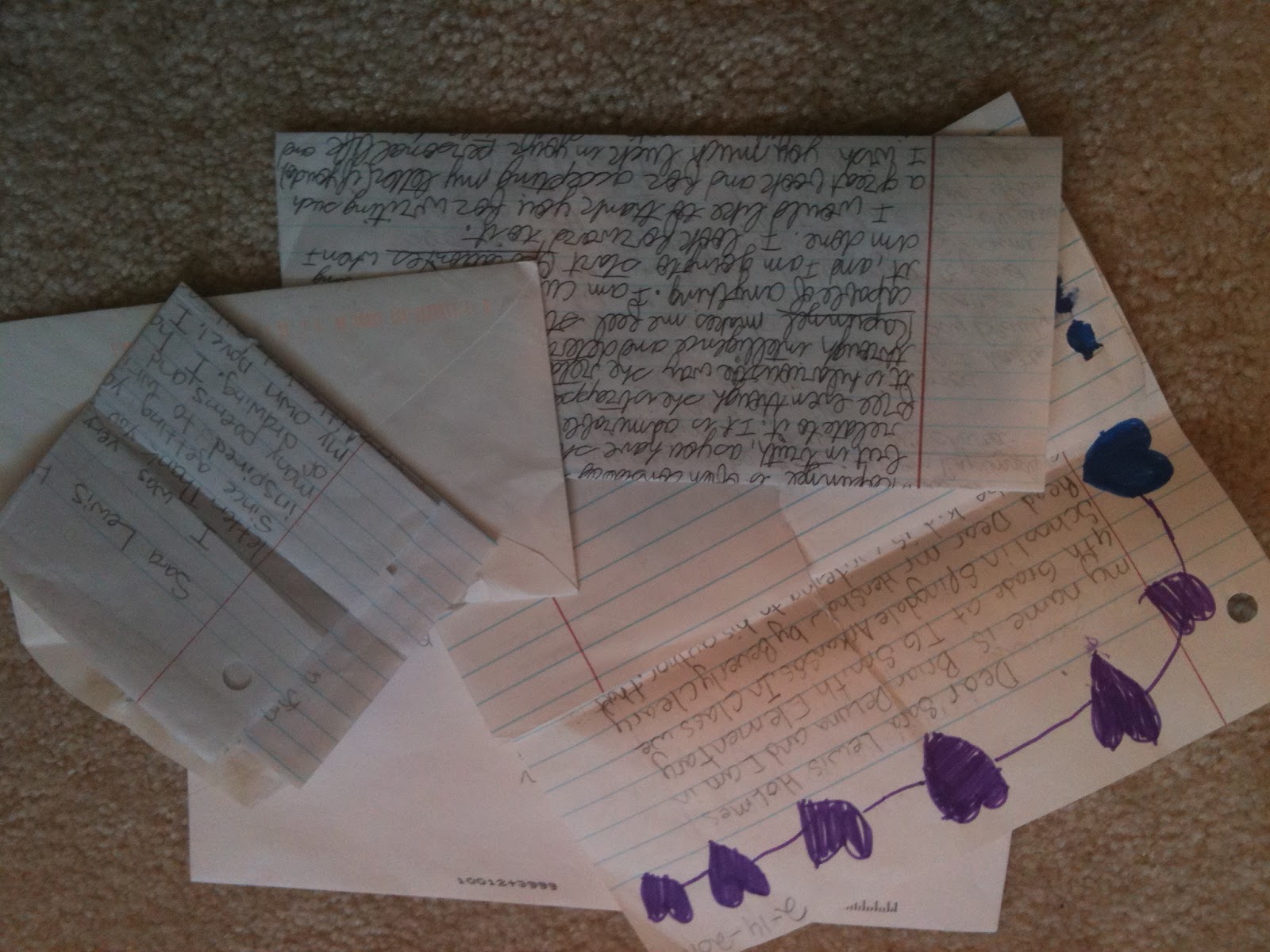
This is an essay I wrote several years ago, before I published (or even wrote) my first book. It chronicles a turning point in my life as a writer, and I dug it out recently because it talks about being seventeen and unsure of your role in life, things that were on my mind as I drove my daughter to college a few days ago. Also, because some of you have asked about the letters I'm lying on in the picture to the right. Here's part one:


Taking It All Off in Knoxville,Tennessee

When I was seventeen, I longed for the day when the clouds would part, the thunder roll, and the voice of Revelation boom: "Hear ye, hear ye! This is thy purpose in life: I have created thee to be a doctor. Go forth and cheat death.” Or: “I have created thee to be a scientist. Go forth and seek truth.” Or even: “I have created thee to be an exotic dancer. Go forth and dance naked on the tabletops of Knoxville, Tennessee."

It didn't matter what the voice commanded. I was desperate to know what I was meant to do in life. The choices were endless and staggering, from Stanford mathematician to Broadway ticket seller. From French pastry chef to Graceland grave guard. I could waste years finding my destined path. Or waste no time at all veering down the road to career hell. At seventeen, every path was a confusing gamble, and only Revelation's booming voice would do as a guide.

Years later, I find myself still awaiting a revelation. No, not a voice announcing what I am to do with my life–somehow I stumbled down the path of a writer and it seems too late to turn back–but I long for a revelation of what I am meant to write. I think I am here to write for children. But am I meant to write easy-to-read primers or lyrical picture books? Fantasy tales of dandies and dragons or biting real life stories of drugs and despair? A novel of teenage sex or a counting book called Ten Aged Socks?

It would be so much easier if Revelation would speak up. A simple "Go forth and ease aching teenage hearts" would be welcome. "Go forth and make fifth-graders giggle" might be fun. I could even tolerate "Go forth scare the pants off pre-teens with hackneyed plots and free-flowing gore" if Revelation were adamant enough.

Until that moment, though, I am in the dark. I do what I used to do in the dark as a kid: read under the covers. I study books about dialogue, books about character development, books about marketing technique. I read in search of answers. Of revelations.

Recently, the book under the covers was The Courage to Write, by Ralph Keyes. What I learned there first shocked, and then shamed me. The shock came on page twenty-eight when I read that some writers hide finished manuscripts in desk drawers. They are terrified of sending them to an editor. Are these writers mad? What use is slaving over the perfect mix of words without a reader to savor the final result? Get it to the starving customers, already!

Yet, the stories of these fearful writers spawned an annoying idea. “Why aren't you afraid to drop an envelope in the mailbox?” it buzzed. "Why don't your stories try to wriggle from your hands and burrow deep into a desk drawer?” Maybe it was because my work was shallow and easily fashioned, instead of deep and fearfully wrought. Maybe I lacked courage. I felt shamed that the only words I’d written that I trembled to send were personal letters.

There was the letter I wrote my first boyfriend, telling him it was over. In it, I swore I loved him (as a friend, of course), but we weren't meant to be. It caused his mother and sister, to whom he showed it, to hate me. We didn't speak again.

There was the letter I sent my parents from college, trumpeting my determination to get married, and detailing the injustice of their opposition. It was about six pages long, passionate, and full of as much confusion as truth. It was written in pain, and induced more pain when it was read.

There were the letters I wrote my husband during our four years of long-distance courtship before we married. Hundreds of letters on such gut-wrenching topics as whether I loved him or not, what I feared most about marriage, and what attracted me to other men. Many of these letters caused major earthquakes when they arrived, and I shook in my shoes as I wrote them and cried after I'd mailed them. At least he didn't show them to his mother. She's a creative seamstress, a generous woman, who might have sewn me into a pillow and donated me to a homeless shelter.

I compared these letters to my more recent work: short stories for children, an occasional nonfiction article, a stab at science fiction for adults, a few word puzzles written out of boredom. My most ambitious project was a one-act play I had begun that month. Of course, I worried about this work: that an embarrassing spelling error would creep in. Or that a story would not meet the needs of the magazine's audience. Or that an article would feature obvious misinformation. But had I trembled to send my words out to editors? No. I was ashamed to admit I had not.

The Courage to Write implied that fear was a natural outcome of writing, like sweat pouring out of skin during ditch digging. Where was my sweat of fear? Maybe I could find it in those early letters. Digging furiously, I unearthed the first letter I had written to my husband and studied it. Lovestruck after just two weeks of dating, and just seventeen, I had composed the following: (continued tomorrow)