Showing posts with label middle grade fiction. Show all posts

Friday, January 20, 2012

What I'm Reading Now: Darth Paper Strikes Back

Darth Paper Strikes Back (Origami Yoda #2)Darth Paper Strikes Back by Tom Angleberger


Is it real? Should I believe? That's what Tommy always wants to know about the paper Yoda finger puppet Dwight uses to dispense wisdom and advice to his classmates. Especially now that Yoda is challenged by another force, Darth Paper, a scorn-spewing puppet wielded by hard-hearted Harvey---and Dwight is sinking under the full weight of a school system which wants to expel him.

The brilliance of this book is that the intended readers---upper elementary and middle schoolers---will absolutely know the answer to the "Is it real?" question. They are long past believing in the magic of inanimate objects. So they get to revel in the question behind the question: What is true?

This is exactly what author Tom Angleberger gives them as his hero, Tommy, with an earnest dedication to justice, gathers stories from his classmates of Dwight's benevolence, with the intent of presenting them to the school board. Each tale ("Origami Yoda and the Pre-Eaten Wiener", "Origami Yoda and the Exploding Pizza Bagels of Love") is told by a different kid---in voices that refreshingly reveal their own struggles and mistakes, but also show Dwight's clearly weird approach to life. What's more, some of the episodes result in outcomes probably not appreciated by the adults at the school (who have to clean up vomit from pre-eaten wieners, after all) and you become seriously worried these stories won't be enough to save Dwight. Especially not when Darth Paper.... okay, I won't ruin it.

Ultimately, this is a story that respects kids enough to let them be juvenile and flawed--- and yet totally affirms their power and goodness in the face of "dark times." Read it you will for the humor, the Star Wars insider jokes, the lunch table power struggles---but changed you will be by the power of paper. And yes, I do mean the paper that makes up the pages of this book. But only because it's real. Only because it makes you believe. And only because it is truly good.

This blog entry is cross-posted on Goodreads

Tuesday, October 4, 2011

How does a story grow?

Worthy stuff:


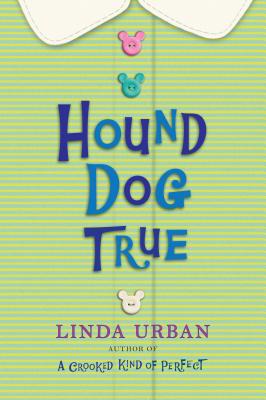
Linda Urban is bravely sharing an early draft of Hound Dog True and opening a discussion of how story happens. 


P.S. Linda is coming to DC!  I'll be getting my copy of HDT straight from her at Politics and Prose. Event details are here. Who's with me?

Tuesday, June 7, 2011

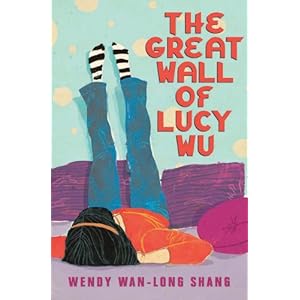
What I'm Reading Now: The Great Wall of Lucy Wu


Made me laugh? Yup.

Made me cry? Yup.

Made me want to use the words "Judy Blume" in this review? Yup.

Sixth-grader Lucy Wu is obsessed with basketball and hopes to play for legendary UT Lady Vols coach Pat Summit one day. But that's a long ways off. For now, she's short, being forced to go to Chinese school, and in an extended battle with mean girl Sloane---who puts crickets in Lucy's lemon chicken. To top it off, she has to share her bedroom with her non-English speaking, Vapor Rub odor-emitting, suddenly visiting great-aunt, Yi Po.

This novel is about walls: at first, the one Lucy erects in her bedroom to keep her great-aunt at arm's length. But later, there's the one in Lucy's school bathroom scrawled with a mocking poem about Chinese people; the walls between Lucy and her basketball dreams; and most of all, the walls inside that we all use to keep other people out...

What I loved most about this book---and what caused me to invoke the name of Judy Blume---is how debut author Wendy Shang keeps Lucy firmly grounded in her family, but gives us complete access to her inner life. Here is Lucy explaining what sharing a room with her great-aunt is like:

"Yi Po woke up every day before the sun even peeped out. And did she tiptoe out quietly? Not without making the bed! I lay in bed and listened to her every morning, walking around in her flat slippers that made a fwap-fwap sound with every step. I soon noticed that she had a little pattern every morning. Whoosh fwap-fwap. She pulled up the blankets. Swish fwap-fwap. She smoothed the bed. Poom fwap-fwap. She puffed up the pillow.
By the time she fwap-fwapped out of the room, I was too fwapping mad to go back to sleep."

No walls there.

Cross-posted on Goodreads.

Wednesday, September 15, 2010

The Fantastic Secret of Owen Jester

In my post from Monday, I also left out that I did some satisfying reading over the summer. At ALA, Barbara O'Connor came to find me during my signing of Operation Yes, and since I couldn't leave to come to her booth, she kindly brought and signed for me an ARC of her latest novel, The Fantastic Secret of Owen Jester. Here we are together (looking somewhat color-coordinated, I must say):


I immediately devoured the ARC in June and posted my initial thoughts on Goodreads, but now that the actual novel is available for sale, THIS is the time to tell you all to go read it!


First of all, isn't that an eye-catching cover? Love it! But just wait until you read the story. I think Barbara's books are hard to write about because so much of their appeal has to do with her vigorous use of language, and the quiet accumulation of detail which soaks in almost unnoticed but results in a feeling of having dived down deep into another world.  This is how I tried, on Goodreads, to capture the saturated goodness of The Fantastic Secret of Owen Jester:

I loved how she built the novel around key sounds---of the passing train, the "fantastic secret's" bumpy arrival, the captured frog's throaty calls, the irritated housekeeper's carping (reminiscent of the faceless adults in Charlie Brown), the one-way conversations with the ill grandfather, the recurring verbal battles between the boys and the lone girl---and many more subtle acoustic details that give the book the wondrous feeling that you are underwater where sounds are magnified.

What's funny is that I didn't even notice the acoustic emphasis until I finished reading and was in the middle of trying to analyse the story. It was like being clued in to a magician's trick. Ohhhhhh. So that's it! Except with each book, Barbara O'Connor seems to conjure up a fresh and intriguing "it."

Go trap your own copy and tell me what you think her "fantastic secret" to writing book after great book is. I wanna know!

For a detailed review (more articulate than mine), see Fizzwhizzing Flushbunker.

Wednesday, January 13, 2010

What makes a good magazine?


One of my favorite Horn Book features is their recurring short feature, "What Makes a Good . . .?" in which they pose a question about children's literature. This inquisitive focus began in the Sept/Oct 2006 issue in which the question "What Makes a Good Book?" formed the spine of the entire issue, dealing with it both generally in long essays ("Finding Literary Goodness in a Pluralistic World") and in shorter pieces which defined good thrillers, beginnings, translated books, poems, holocaust books, second grade books, bookstore books, fantasies, and endings. On that last one, Virginia Euwer Wolff says "If I give myself over to a book and let it absorb me, I want its ending not to let me go back to the self I was before I read it." Think on that, writers!

The answer to the posed question usually forms a short article, as the one below, "What Makes a Good Read Aloud for Middle Graders?"


I love author Christine McDonnell's choice of Lloyd Alexander's The Book of Three as a stellar read aloud. As she says, "Alexander's Prydain series has language that flows like a song and characters whose speech is wonderfully idiosyncratic." Indeed.

But even if she hadn't riveted me by citing my favorite book of all time,  I would've read the entire article with attention, respect, and delight. Because if I had to answer the question, "What Makes a Good Magazine?" I would answer "The Horn Book"---while gleefully flinging open my closet doors to show you the stacks of back issues I've hoarded through the years.

But as Horn Book readers know, there is no assertion like the one I just made without backing it up with well-chosen, linguistically honed, and tightly woven reasons.  So here you go:

What Makes a Good Magazine?

1) It asks questions---continually---of itself and of its readers.

As Parker Palmer says: "Each of us has an inner teacher, a voice of truth, that offers the guidance and power we need to deal with our problems. But that inner voice is often garbled by various kinds of inward and outward interference. The function of the Clearness Committee is not to give advice or "fix" people from the outside in but rather to help people remove the interference so that they can discover their own wisdom from the inside out." (Source)

I hesitate to call The Horn Book a "clearness committee" because it sounds creepily like Doublespeak, but I do think the questions posed in its pages help remove some of the fuzzy thinking that creeps into any group of people devoted to A Good Thing (even children's books.)

(Furthermore, occasionally, as in the current issue on color, The Horn Book models its own proposed answers:  "Color is not just decorative but elucidating." I agree. The full color interior of the refreshed Horn Book makes it much easier to read and enables readers to experience illustrations and cover art as they were meant to be.)

2)  It does not bore. Everything now seems to be blandly academic (if not frozen-cheeked, cheerily PC) or louder-than-thou personality driven without regard to reason or facts. (Think cable news. And yes, I do think raving without facts is boring.)

Rather, The Horn Book conducts the conversation about the topic at hand---be it "retro" picture-book art as considered by Leonard Marcus or an ode by artist Melissa Sweet to the particular shade of pink dubbed "Opera" or (to cite a piece from an older issue) a matter-of-fact discussion of "bad language" in “The Pottymouth Paradox,” by Patty Gauch --- with style and good manners. There is no dull writing here. But neither is there any hair-pulling.

3) It reviews books that I want to read.

I guess that's simplistic. And personal.  And it may even be a flaw, at least in relation to my book buying budget. But if I didn't consistently add to my To Be Read List after finishing each issue, I would be looking for a different review source.

From the current issue, I fell in love with Geraldine McCaughrean's new novel, The Death-Defying Pepper Roux, entirely upon the basis of one image-laden quote the reviewer cited from the book:  Pepper's mother and aunt "leaned in against [his] childhood like a pair of bookends---big, ponderous women, and so full of tragedy they could barely hook their corsets closed." (Okay, and because I loved McCaughrean's The White Darkness.)

I also noted the thoughtful review of the Hilary McKay sequel to A Little Princess ---still making up my mind as to whether to read it but the reviewer's perspective was clearly helpful---and the intriguing description (and full color, hot-pink book jacket) of How to Say Goodbye in Robot.

And that's it. Three good reasons why The Horn Book is a good magazine. And why, if you ever visit me, I might send a sample back issue home with you. (I have to clear out my closet somehow.)

Wednesday, December 16, 2009

Letters (and Reviews and Interviews) of Note

When you have a new book child out in the world, it's nice when your first book child gets a little loving, too. On Monday, Valerie Geary posted a thoughtful review of Letters From Rapunzel, and today, she's featuring an interview with me about writing (and reading) middle grade fiction. Thank you so much, Valerie! She's exploring the middle grade genre for all of December, so bookmark her blog and check back the rest of the month.

P.S. (There's always a P.S. when I'm blogging about Letters From Rapunzel---have you noticed?)  My sister sent me a link to this intriguing blog called Letters of Note. The site posts scanned PDFs of original letters and then transcribes them so they're easier to read. A sampling: J.D. Salinger's letter, refusing to sell the screen rights to A Catcher in the Rye; inventer Nikola Tesla writing to the Red Cross, predicting contact with other life forms; Robert Heinlein's hilarious "tick the box" form letter to fans who wrote him. (One of them is "please don't write me again." Ha! I think my Rapunzel would've been a kindred spirit to Mr. Heinlein.)

Wednesday, October 1, 2008

Why I Write Middle Grade Fiction

Two things have been going on:

the revisions for my second middle grade novel, The New Recruit, which must be put to bed by mid-November or so

the slow drafting of an unnamed YA novel

But...then another thing happened. In the midst of the revisions, I suddenly wanted to write another middle grade novel really badly. Not that I want to stop with the YA. But I realized how much I love middle grade. I think it was this definition from the Cybils that did me in:

"The middle grade years are, in my view, the reading years with the most potential to turn a child into a reader for life. It's often the books you read between the ages of 8-12 that you remember long into adulthood as your dearest books of all. These are the years when kids really and truly start to figure themselves out as readers--their likes and dislikes and all the rest in between. It's during this time when children strike out on their own in earnest, reading for themselves and by themselves, all the while creating themselves.

In this Cybils category, we're looking for stories that capture real life in all of its wonderful messiness. So we're not talking magic or superheroes or werewolves or elves. Instead, think adventures and school stories, mysteries and stories about families, and tales that tell kids of life across the globe. Tell us which of the Middle Grade fiction titles published this year you think kids will still be talking about when they're all grown up, and still reading away."

--Kerry Millar, organizer

Nominations are open! Go quickly and nominate your favorite middle grade book!

Or once in any of these nine categories.

Tuesday, September 11, 2007

Stuck in the Middle With You

I'm a middle child. That can't be why I write middle-grade fiction, can it? That would be illogical. But then again, some say birth order plays a role in career choice. (Rebuttal: here.) Has anyone ever surveyed writers to find out if birth order correlates to what they write?

Meantime, while all of you are researching that (and if you want, posting your birth order and writing/reading preferences in the comments) check out these posts about middle school and middle-grade readers. And yes, it's confusing that middle school is usually 6-8th grade students (ages 11-13) who are reading both up and down in grade level, while middle-grade books are often labeled for grades 4-6 (ages 8-12.)

First: Here's a YouTube soundtrack of Stuck in the Middle With You (set to X-Files clips!) for you to listen to while you peruse. (Also: Stuck in the Middle with You: Wikipedia entry) Wow! I'd forgotten that I really LIKE this song.

Links:

Interview with three sixth-grade girls (Courtesy of Danette Haworth's blog)

Uncensored answers to "Im going into middle school I want to know whats going on there?"

Middle Grade is a Muddy Name (ShelfTalker at Publishers Weekly)

How To Impress Middle School Boys
(WikiHow)

Betsy Bird's definition of middle-grade fiction for the Cybils Awards

The Difference Between Middle-Grade and Young Adult Fiction
(from Children's Book Insider)

Books for the Ages: Or Why I Don't Use the Term MG (Little Willow, and be sure to read the awesome comments section)

Is a Sixth-Grader a Young Adult? (Mitali Perkins. Keep pressing for more middle school lists, BTW. VOYA's got one: TopShelf Fiction for Middle School Readers.)

Middle Children Get the Worst Deal (I don't agree. I liked being a middle child. Except when my older sister got to sit in the front seat and I was forced to sit in the back seat between my two younger brothers while they poked and generally annoyed the crap out of each other. Thus, a peace-maker and a "maybe I'll imagine I'm really somewhere else" writer was born.)

***Don't forget to leave your birth order and writing/reading preferences in the comments, if you want to participate in this most unscientific survey.